
Morning Fog
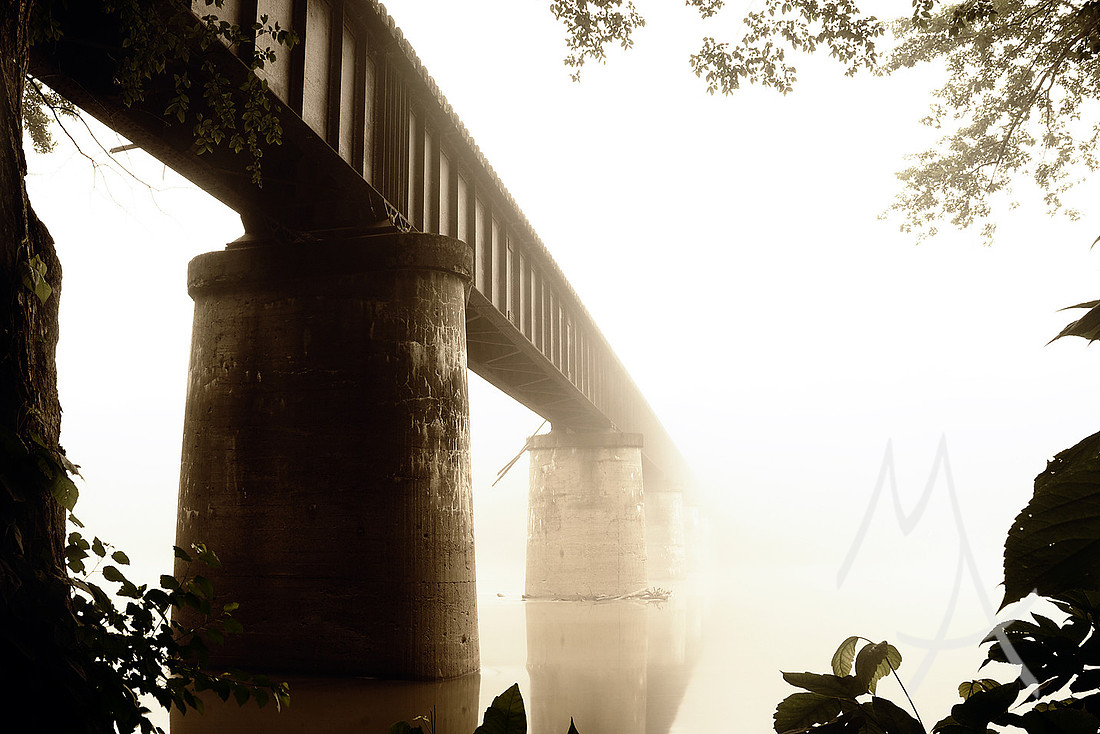

© 2014 Michael Allio
In the Camera - Nikon D610 - Nikkor 18-70mm f/3.5-4.5 lens - Aperture: f/16 - Shutter Speed: 2.5 seconds - ISO: 100
This photo was taken at about 5:30 in the morning. I woke up to the dog needing to go outside. As it turned out, it was a foggy morning. I grabbed the camera and a tripod and high-tailed it to a location I had scouted out. The subject of the photo is the Indianapolis, Bloomington and Western (Big Four) Railroad Bridge (c. 1869-1982) over the Wabash River (Covington, Indiana). Abandoned since before I was born, the train trestle is now a fixture as a part of the City of Covington's riverside park. From a distance you can see the remnants of graffiti painted on the side of the metal (below). At one point it clearly said "Truly seek Jesus."

Operating in Indiana, Illinois, and Ohio, the Indianapolis, Bloomington and Western (Big Four) Railroad was formed in 1869. A terminal was built in east Urbana, Illinois in 1871. This terminal is now used by the C-U MTD (Mass Transit District) as a hub. According to cumtd.com, the last passenger train passed through Urbana in 1959.
Today's photo was taken about a mile from where we currently live in Covington. The terminal is about three miles from our house in Champaign.
Lens Reversal

© 2014 Michael Allio
In the Camera - Nikon D610 - Nikkor 50mm f/1.8D Lens with lens reversal ring - Aperture manual f/8 - Shutter Speed 1/125 sec. - ISO 3200
This photo was taken using a special piece of equipment called a lens reversal ring. It allows the photographer to turn the lens of the camera around, essentially attaching it backward facing onto the DSLR. Why would you want to do this? By using this setup it allows the photographer to get closer to the subject. Many lenses have a minimal distance that the camera must be away from the subject, otherwise the object will begin to lose focus. The downside to this process is, now everything must be set manually (including the aperture being set directly on the lens). The only thing the CPU of the camera does for the photographer is to set the shutter and film speeds.
The photo is of a Lily (Lilium) growing in our container garden.
First Time Lapse
Copyright 2014 Michael Allio
This was my first attempt at creating a time lapse video. It was taken at Body 'n Sole Sports, a running specialty store in Savoy, IL as they were working on remodeling their store. This was a fun project and I am looking forward to attempting this outside with a scenic setting.
The 1080p video is composed of 975 stacked images. Compiling the video was the job of the camera. It is a great new setting from Nikon as it would have taken several hours to put the video together otherwise.
As I work with this feature I hope to figure out if there is a way to extract an individual image from the video. If any of you have experience with shooting time lapse video in this format please leave a how-to comment below. Thanks!
In the Camera - Nikon D610 - Nikkor 18-70mm f/3.5-4.5 lens - Aperture: f/4.5 - ISO: 1250 - White Balance: Kelvin - Aperture priority - Time Lapse: one picture every eight seconds for 2 hrs 10 mins
Goslings

© Michael Allio 2014
In the Camera - Nikon D610 - Nikkor 70-300mm f/4-5.6 Lens - Aperture f/5.6 - 1/1600 sec. - ISO 400
The last post was a wildlife photo, and so is this one. After the cold winter we had it is tough not to find a way to get out the door. And, with all the trails nearby it becomes that much easier. The photo above is of Branta canadensis, or the Canada Goose. The two in the photo are juvenile. We live in a small band of latitude where these birds can be found year round. North is the summer breeding grounds while south is where they will travel for warmer weather. There are several other photos, including some pics of adult geese, on the wildlife page.
Spring Time

© 2014 Michael Allio
In the Camera - Nikon D610 - 60mm Nikkor f/2.8 Lens - Aperture f/8 - Shutter Speed 1/40s - ISO 6400
Turdus migratorius, American robin hatchlings sleep in their nest.